The Textsmith Primer
A Philosophy of Digital Writing
Welcome
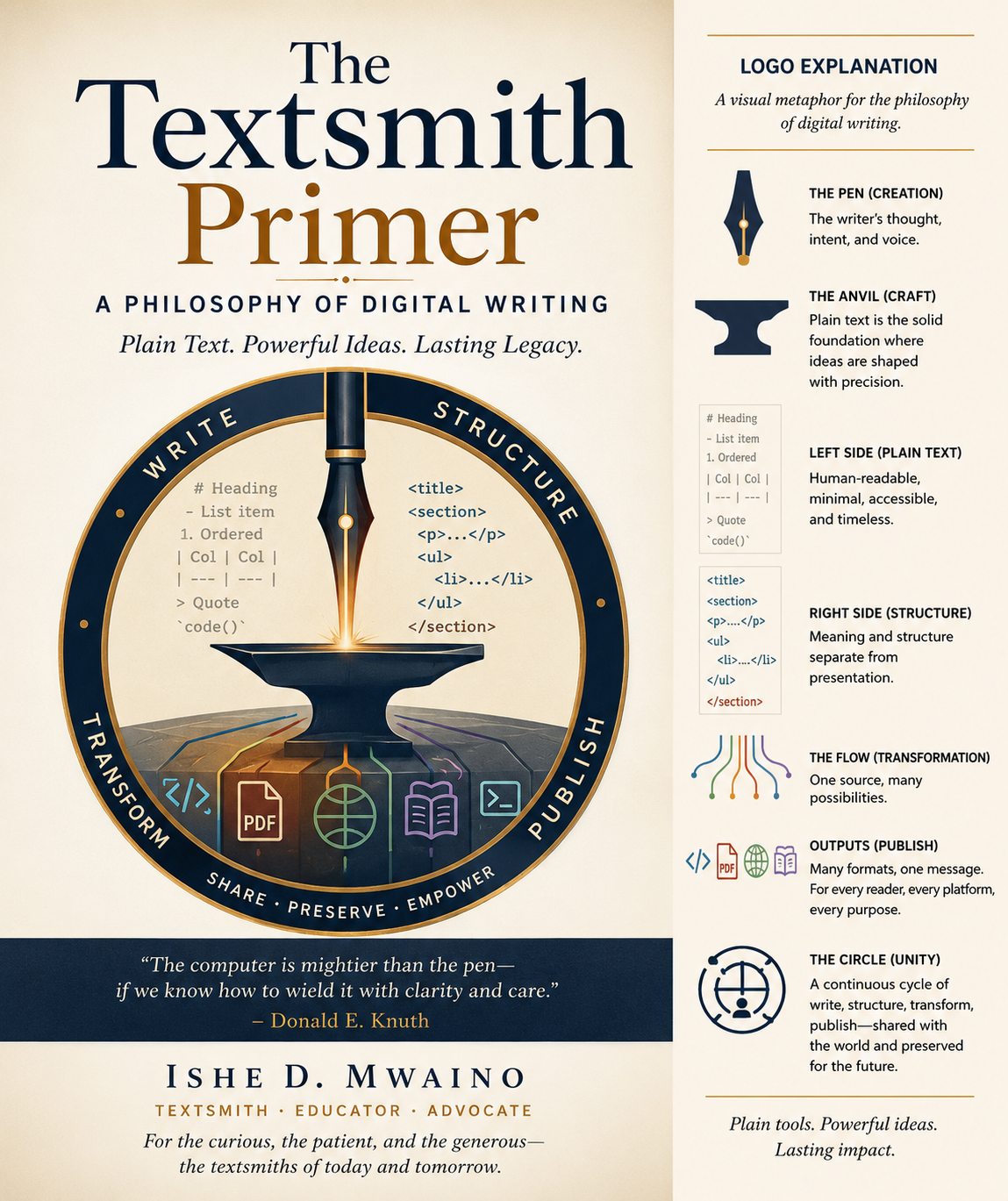
Plain text is one of the simplest technologies in computing.
It is also one of the most powerful.
It carries source code, configuration, research, documentation, books, websites, data, diagrams, and conversations with artificial intelligence. It survives changing applications, operating systems, and generations of hardware because it places ideas before software and structure before appearance.
The Textsmith Primer explores the philosophy, tools, and traditions that have grown around this enduring medium.
It is written for the curious beginner, the experienced practitioner seeking a wider perspective, and anyone who believes that digital writing should remain accessible, understandable, portable, and capable of outliving the tools used to create it.
Plain text is the medium. Markup gives it structure. Text processing gives it power. Publishing gives it form. The textsmith gives it purpose.
A Journey Through the Plain-Text Universe
The primer unfolds in five parts.
Part I — The Foundations of Plain Text
Discover what plain text is, why it endures, how computers encode it, and how the Unix philosophy transformed it into a universal medium of computation.
Part II — Markup Languages
Explore how HTML, XML, TeX, Markdown, AsciiDoc, reStructuredText, Typst, Mermaid, and Graphviz teach ordinary characters to express structure, mathematics, documents, and diagrams.
Part III — Text Processing
Enter the forge of the textsmith, where grep, regular expressions, sed, awk, the shell, structured data, search, and automation turn text into a powerful working material.
Part IV — Publishing
Follow a manuscript as it becomes a book, website, article, technical manual, presentation, or dashboard through Pandoc, Quarto, and the wider publishing ecosystem.
Part V — The Textsmith’s Workshop
Meet the craftsperson behind the tools. Build habits of note-taking, version control, automation, public writing, preservation, ethical authorship, teaching, and thoughtful collaboration with artificial intelligence.
More Than a Software Manual
This book does not ask you to memorize every command or adopt one approved collection of tools.
It asks you to understand the questions that tools answer.
Where is the information?
What structure does it possess?
How can it be transformed?
How should it be preserved?
Who needs to receive it?
Once those questions become habits, unfamiliar tools become less intimidating. Technology changes, but the principles of craftsmanship remain.
Who Is a Textsmith?
A textsmith is not defined by a preferred editor, operating system, or markup language.
A textsmith is someone who cares for ideas.
They seek clarity before decoration, structure before formatting, understanding before automation, and communication before publication. They preserve what they learn and share it generously with others.
This primer is an invitation into that craft, its history, and its community.
The workshop is open.